


Manitoba’s pharmacists want more prescription power
Pharmacists in Manitoba say they want to do more for patients but can’t until changes are made by the provincial government. "The training that pharmacists have goes pretty far," said Brandon pharmacist Mark Mercure. "We can
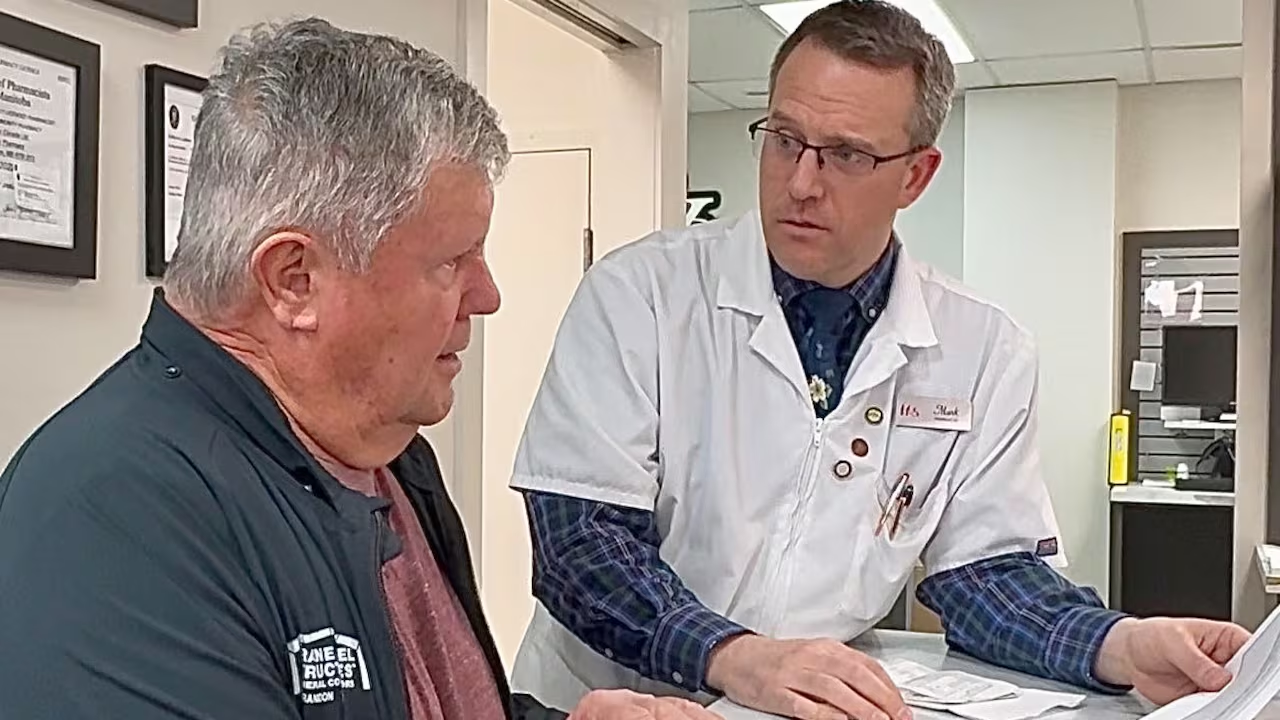
Pharmacists in Manitoba say they want to do more for patients but can’t until changes are made by the provincial government.
“The training that pharmacists have goes pretty far,” said Brandon pharmacist Mark Mercure. “We can take a lot of the burden off of the health-care system, which is pretty burdened at the moment.”
Pharmacists hope legislation changes so they can use more of their training, he said, more in line with what pharmacists can do in other provinces, like Alberta.
Pharmacists there have greater authority to assess patients and prescribe medication, administer more vaccines and offer substitutions if the medicine prescribed by a doctor is not available.
“A lot of times, there’s a very suitable substitute available that we’ll know about, but we can’t just change the doctor’s prescription without getting the doctor’s permission,” Mercure said.
“If we can simply make those changes, then we would save a lot of the doctor’s time, make it a little bit more convenient for customers and patients.”
Debbie English gets vitamin B12 injections every two weeks from Mercure at Home Health Care Pharmacy.
“I know I’m in good hands,” English said.
She used to get vitamin B12, which helps promote healthy blood cell production in her body, once a month.
“The pharmacist noticed that I wasn’t doing well. I was very sluggish,” English said.
“And he phoned my doctor and requested that they be upped to once every two weeks. I was amazed that he took time to do that.”

Pharmacists have always flown under the radar, said Jennifer Ludwig, a Brandon pharmacist with 20 years of experience.
They have filled the gap in rural areas where there is a shortage of physicians and nurse practitioners, and they’re among the most accessible health care providers, she said.
“There could be times when a doctor’s not available, or maybe the ER is closed for a few days or a few hours, or the health centre is only open periodically through the week,” Ludwig said.
Pharmacists Manitoba, an advocacy association, represents almost 1,200 pharmacists working in about 500 community pharmacies.
Spokesperson Britt Kural said Manitoba is “dead last” in all provinces when it comes to allowing pharmacists to assess for minor ailments and many other types of services.
She’s lobbying the provincial government to make changes to the Pharmaceutical Act to bring Manitoba pharmacists’ scope of practice up to par with the rest of Canada, and make them completely publicly funded.

“In Manitoba, we are authorized to do assessments and prescribing for 14 different types of common ailments. But when you look at Ontario, at Saskatchewan, they’re doing two or three times as much as we are,” she said.
“If you look at Alberta, they’re actually doing up to 58 different types of common ailments. It’s very discouraging.”
And Manitoba Health pays pharmacists for assessment and prescribing for only one of the ailments — urinary tract infections.
Patients have to pay out of pocket for pharmacist assessments and prescriptions for the other ailments, including nausea and vomiting in pregnant women, poison ivy, minor skin conditions and seasonal allergies.
“That doesn’t sit well with pharmacists,” Kural said.
Doctors Manitoba said physicians deeply value the expertise of pharmacists, but what is needed is team-based care.
President Dr. Nichelle Desilets said the goal should not be creating “more parallel silos.” That approach causes fragmentation and duplication in services, she said.
“Patients should not be left to navigate the system on their own. A fragmented system is not just frustrating for patients, it is more costly for taxpayers,” Desilets said in an email to CBC.
Last year in May, Health Minister Uzoma Asagwara told pharmacists they would be able to prescribe birth control and HIV medications.
On Thursday, Asagwara told CBC that pharmacists are able to prescribe HIV medication and “birth control work is well underway.”
“We are going to be expanding the minor ailments list because we know increasingly that a pharmacist is that point of contact for primary care for many folks. So we want them to practice in their full scope,” Asagwara said.
“The pharmacist is the most accessible point of contact for primary care, and we want to make sure that they can do more for Manitobans, not less.”
Source: https://www.cbc.ca/news/canada/manitoba/manitoba-pharmacists-legislation-change-assess-prescribe-9.7183318?cmp=rss